Sliding window algorithm
Greetings! I'm Vishnu Vinay, a Computer Science and Engineering graduate holding a B. Tech degree. Currently immersed in the captivating world of Artificial Intelligence, I am on a quest for knowledge while pursuing a graduate certificate in Artificial Intelligence with Machine Learning. My passion lies in sharing insights and discoveries in the fields of AI, Machine Learning, Artificial General Intelligence, and Robotics through engaging blog posts. Proficient in Python, ML libraries, and algorithms, I find joy in developing and deploying ML models, with a focus on leveraging AWS Sagemaker. Join me on this exciting journey of unraveling the mysteries of AI through the lens of coding, exploration, and the ever-evolving landscape of machine learning. Let's embark on this knowledge-sharing adventure together!
Say, we have an array 'arr' of size 'n'. We will use a window of a certain size that slides through the entire array, giving us all the possible sub-outputs or sub-array.
Thereby, giving us the final answer we need in the best complexity.
Example:-
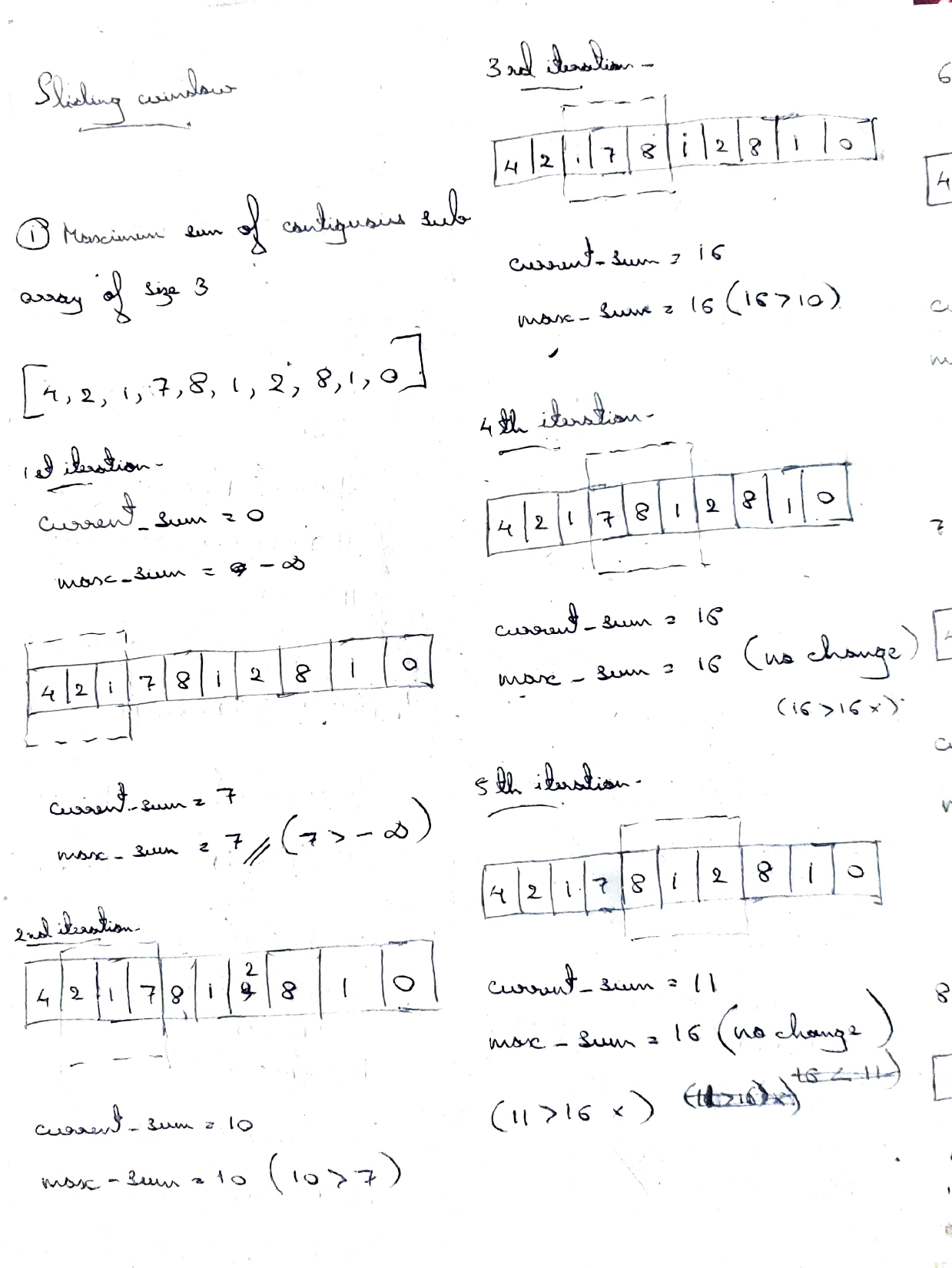
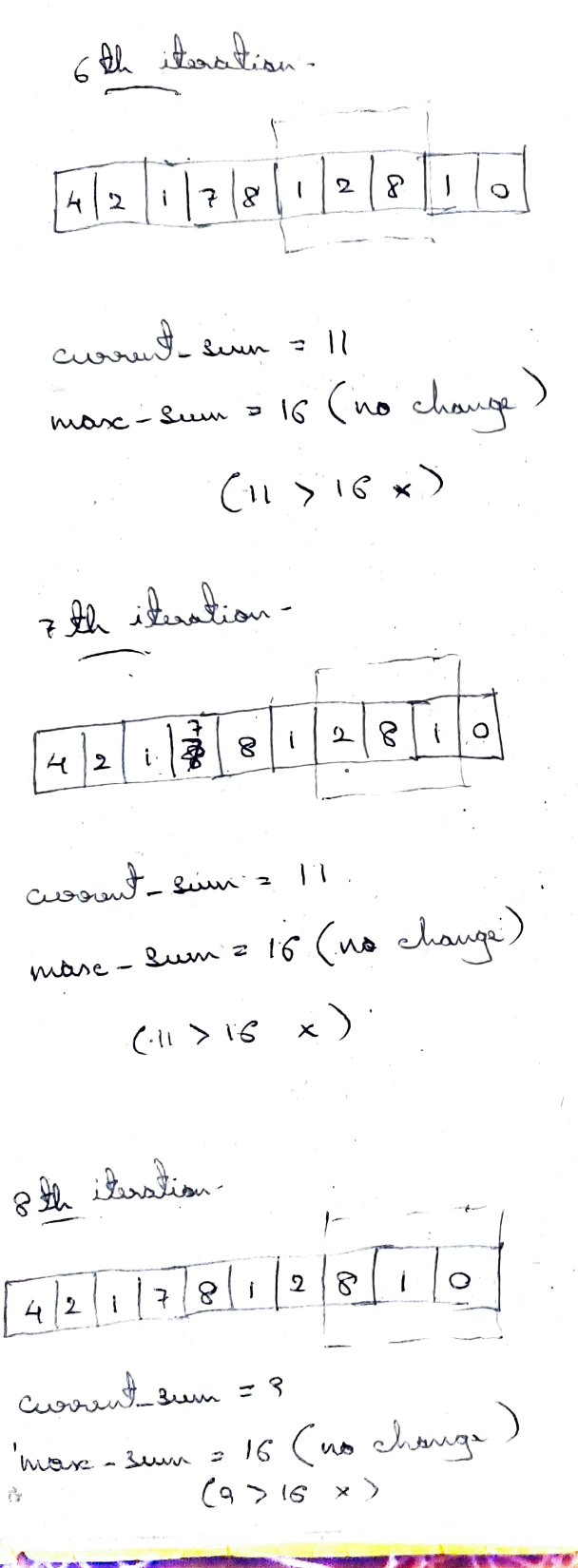
Implementation:-
package Arrays;

import java.util.Scanner;

public class LargestSumContinuousSubArray {
    // Sliding window algorithm -> O(n)
    static int largestSum_OptimizedV2(int[] arr, int size, int window_size) {
        int curr_sum = 0;
        int max_sum = Integer.MIN_VALUE;

        for (int i = 0; i < size; i++) {
            curr_sum = curr_sum + arr[i];

            // window condition
            if (i >= window_size - 1) {
                // updating maximum sum value
                max_sum = Math.max(curr_sum, max_sum);
                    // deleting the left most element in order to maintain the window size when it iterates
                    curr_sum = curr_sum - arr[i - (window_size - 1)];
                }
            }

        return max_sum;
    }

    // Brute force approach - O(n^2)
    static int largestSum(int[] arr, int size) {
        int max_sum = -999;
        int sum = 0;

        for (int i = 0; i < size; i++) {
            sum = arr[i];
            for (int j = i + 1; j < size; j++) {
                sum = sum + arr[j];

                if (sum > max_sum)
                    max_sum = sum;
            }
        }
        return  max_sum;
    }

    public static void main(String[] args) {
        Scanner sc = new Scanner(System.in);

        int size = sc.nextInt();

        int[] arr = new int[size];
        for (int i = 0; i < size; i++)
            arr[i] = sc.nextInt();

        int window_size = sc.nextInt();

        System.out.println(largestSum(arr, size));
        System.out.println(largestSum_OptimizedV2(arr, size, window_size));
    }
}
Dynamic size sliding window:-
Similar to the sliding window, except that the window can shrink and expand upon iteration.
Example:-
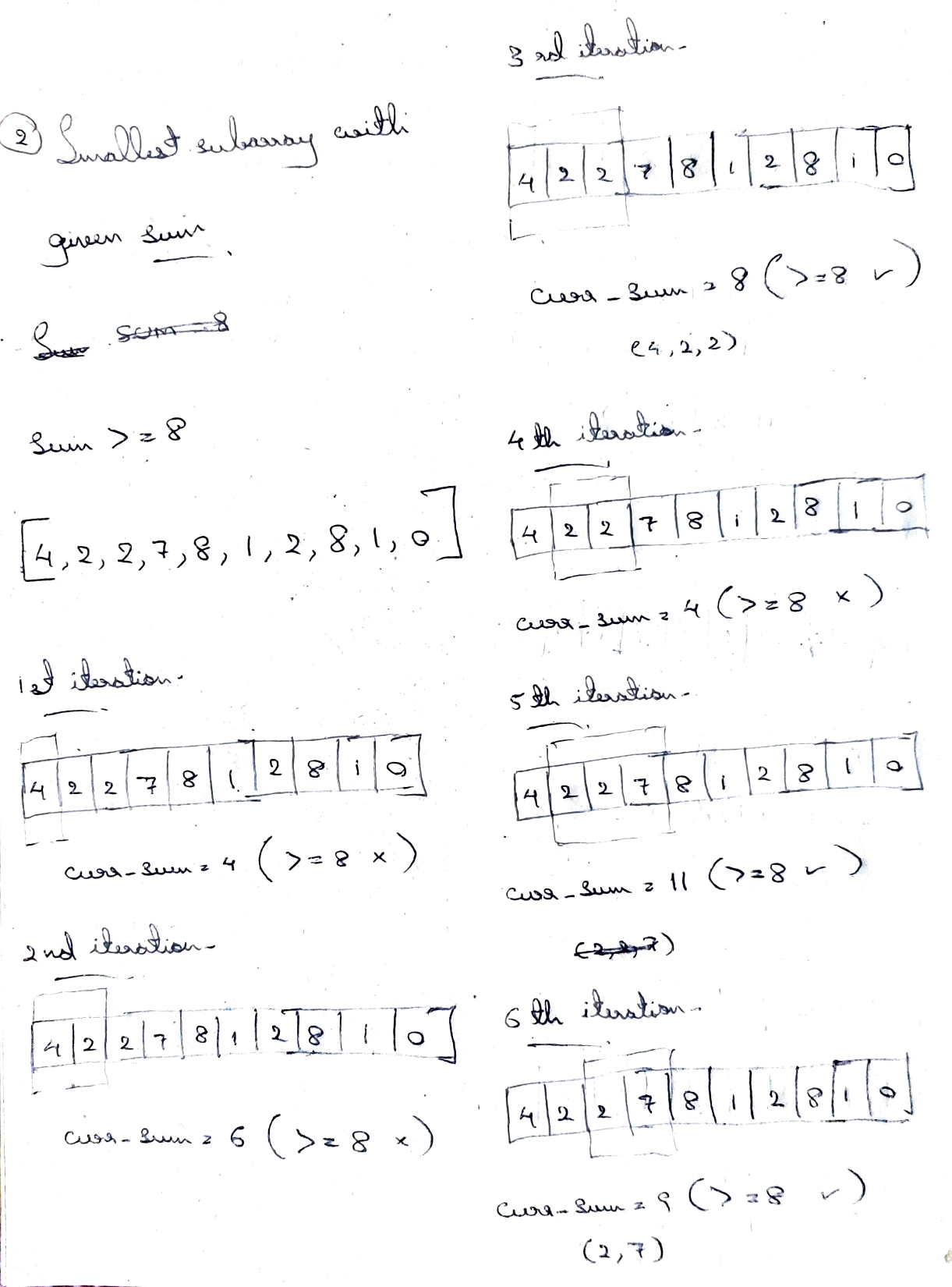
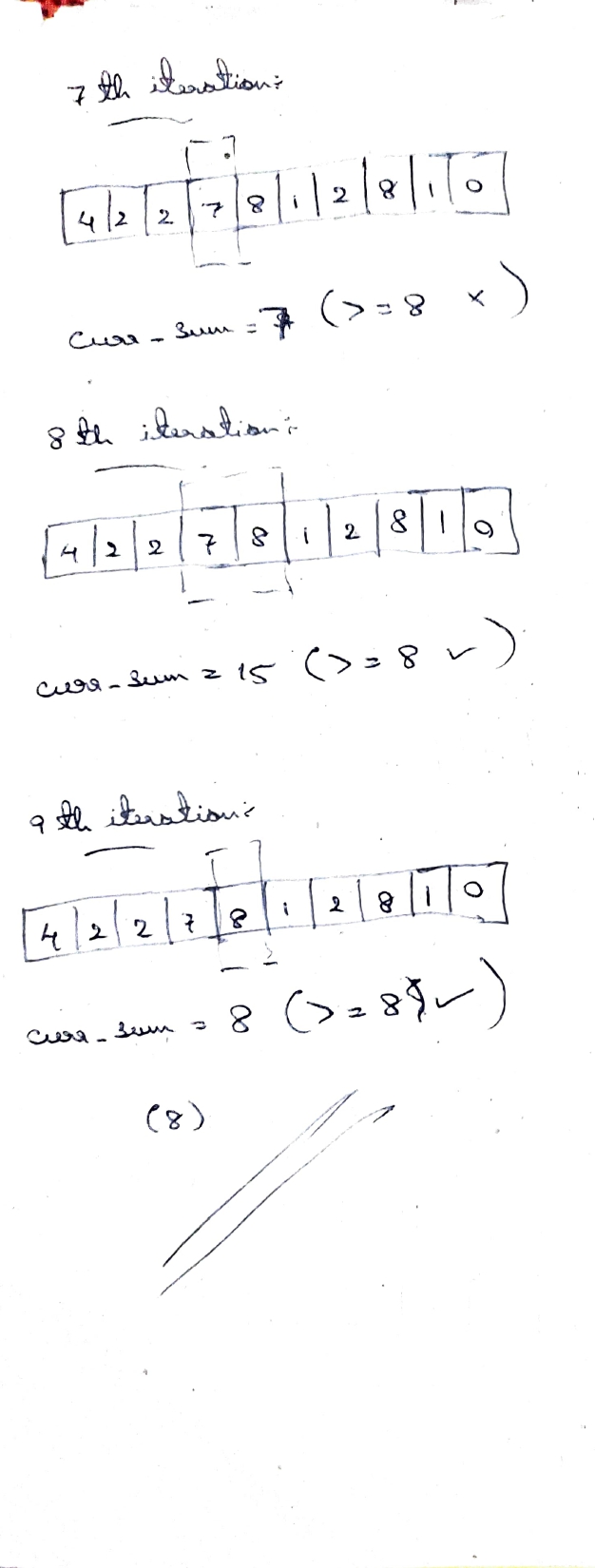
In the 3rd iteration, we got a subarray with sum = 8 and size = 3. Thus, we got the final output.
In the 5th iteration, we do get a subarray with sum = 8. However, the size remains the same. Thus, we neglect it and move forward by shrinking it.
In the 6th iteration, we get a subarray with sum = 8 and size = 2. Thus, it became our new output.
In the 8th iteration, we do get a subarray with sum = 8. However, the size remains the same. Thus, we neglect it and move forward by shrinking it.
In the 9th iteration, we get a subarray with sum = 8 and size = 1 which is our base case by default. Therefore, we stop the iteration.
Implementation:-
package Arrays;

import java.util.Scanner;

public class SmallestSubArrayWithGivenSum {

    /*
    Given an array 'arr' of size 'n'. Find the smallest sub-array size with the given target sum.
    Dynamic sliding window - O(n)
    */
    static int smallestSubArray(int[] arr, int size, int target_sum) {
        int minSumArraySize = Integer.MAX_VALUE;
        int curr_sum = 0;
        int window_start, window_end = window_start = 0;

        while (window_end < size) {
            curr_sum = curr_sum + arr[window_end];

            while (curr_sum >= target_sum) {
                // getting the size of the sub-array with minimum size
                minSumArraySize = Math.min(minSumArraySize, window_end - window_start + 1);
                // eliminating the first index element from sub-array
                curr_sum = curr_sum - arr[window_start];
                window_start++;
            }

            window_end++;
        }

        return minSumArraySize;
    }

    public static void main(String[] args) {
        Scanner sc = new Scanner(System.in);

        int size = sc.nextInt();

        int[] arr = new int[size];
        for (int i = 0; i < size; i++)
            arr[i] = sc.nextInt();

        int target_sum = sc.nextInt();

        System.out.println(smallestSubArray(arr, size, target_sum));
    }
}